A new book by Shlomo Kashani

To Deter,
Not to Disarm:

The Fourth Leg and the Ethics ofHypersonic Nuclear Weapons

What remains of deterrence when speed outruns judgment?

Warning can vanish inside a few minutes. Four quantified, prospective war games test whether governments can identify the threat, consult allies, protect civilians, and retain lawful political control before uncertainty hardens into irreversible action.

01Warning 02Interpretation 03Protection 04Restraint
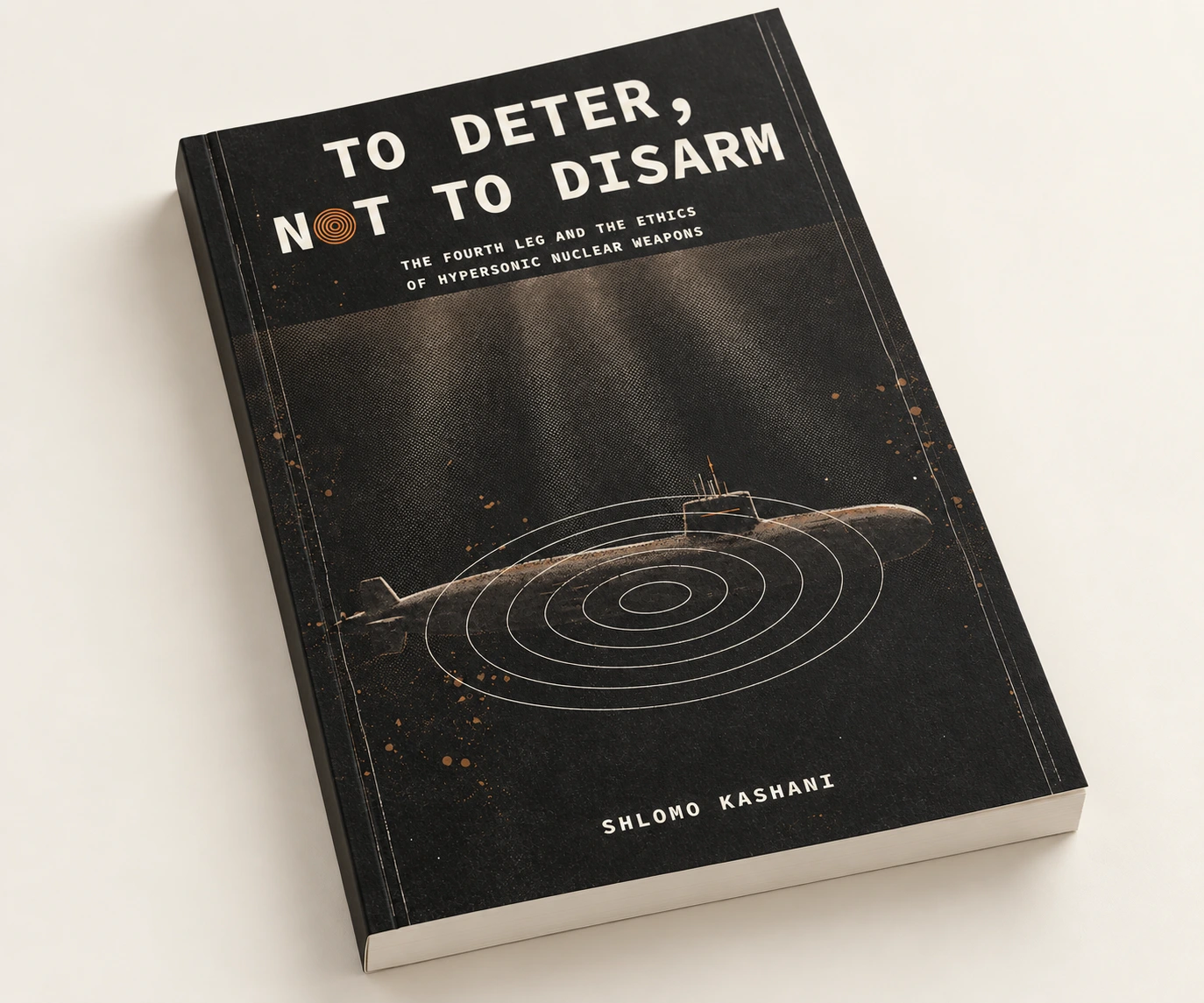
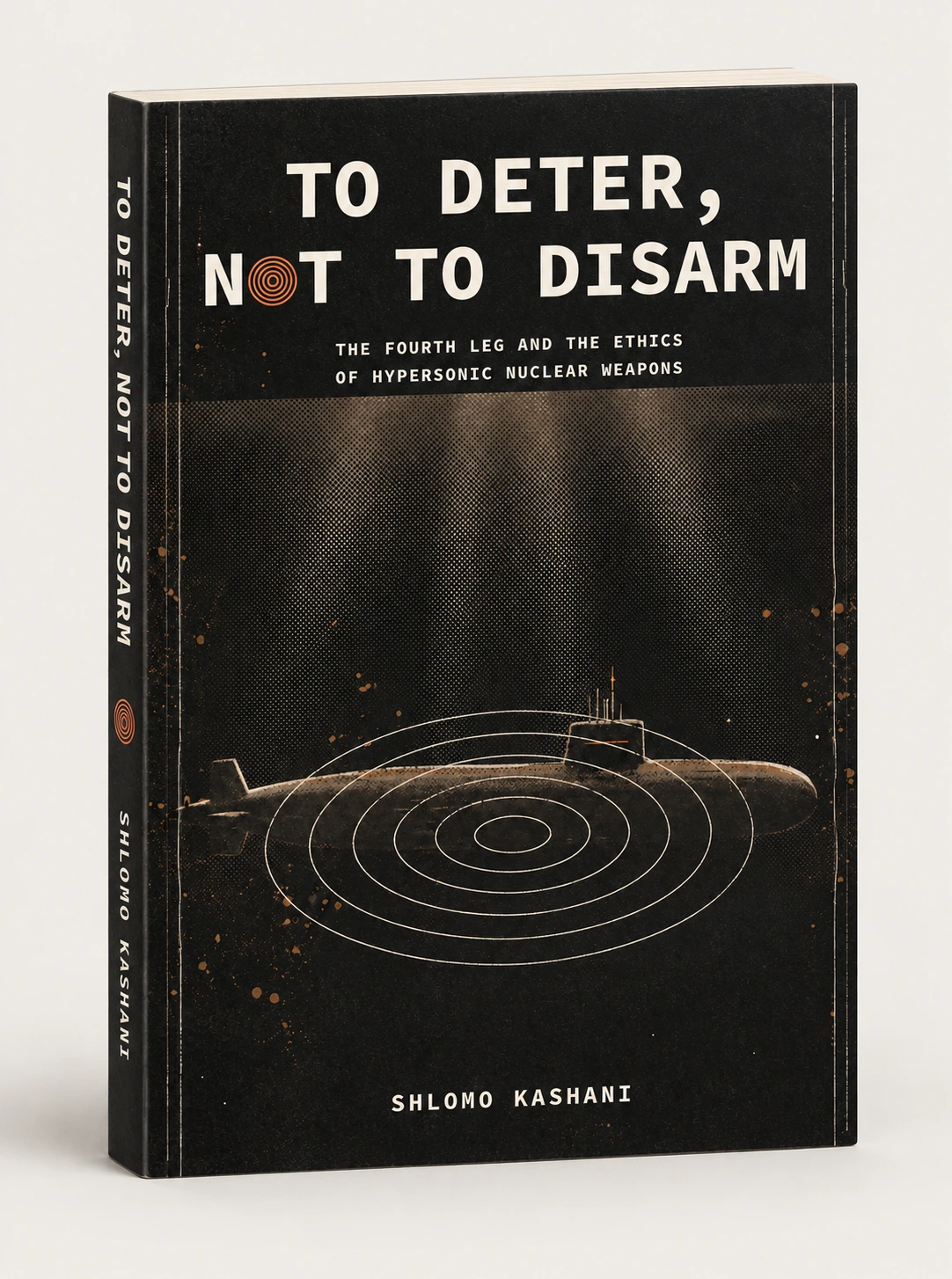
Upright A4 softcover mockup of To Deter, Not to Disarm: The Fourth Leg and the Ethics of Hypersonic Nuclear Weapons

Complete manuscript · 274 pages

133,000Words
15Chapters
36Tables & figures
4Prospective war games

Warning

Disciplined interpretation

Protection and consultation

Lawful political choice

Detection becomes automatic response

The argument in brief

Preserve the time needed to choose

To Deter, Not to Disarm asks what a government must still be able to do when warning time falls from hours to minutes. The book argues that deterrence needs a fourth leg: bounded protection that preserves political choice without promising invulnerability.

Warning, sensing, interception, shelters, continuity, alliance consultation, and lawful authority belong in one defensive architecture. They strengthen deterrence only when they protect civilians, expose uncertainty, and leave nuclear release in political hands.

Exercise control online Fictional prospective simulation

Crisis feed

Select a theatre. The terminal replays a controlled decision sequence from the book’s war-game architecture.

Open-source exerciseClock: liveAuthority: political

Dramatised interface; analytically faithful. No real codes, coordinates, target data, launch procedure, or completed exercise result is represented.

Three-quarter view of the A4 softcover To Deter, Not to Disarm: The Fourth Leg and the Ethics of Hypersonic Nuclear Weapons

A4 softcover · Strategic studies · Nuclear ethics

The Book

When time itself becomes a strategic weapon

To Deter, Not to Disarm argues that hypersonic systems change deterrence not through speed alone, but by reorganising the conditions under which political judgment, civilian protection, and restraint must operate.

A hypersonic missile launched under nuclear shadow can reach its target before governments have fully decided what they are seeing, who is in danger, or whether a defensive move will calm the crisis or widen it. Classical deterrence still requires survivable retaliation, credibility, signalling, and escalation control. Under severe time compression, those foundations no longer suffice on their own.

Shlomo Kashani develops two linked theories—hypersonic deterrence under compression and bounded protective defence—to explain when a defensive fourth leg can preserve stability and when the same capability produces the crisis it was meant to prevent.

Four quantified war games place that argument under pressure across India–Pakistan, United Kingdom–Russia, United States–North Korea, and escalation towards general nuclear war. They use declared flight-time ranges, matched controls, six decision gates, and casualty and damage ledgers. They are executable open-source designs, not reports of exercises already conducted.

The proposed fourth leg is not a promise of invulnerability. It joins assured retaliation to warning, sensing, interception, shelters, continuity, alliance coordination, and tightly governed hypersonic roles. Its purpose is to preserve usable choice: enough time to interpret, protect, consult, and keep nuclear decisions under lawful authority.

The argument is deliberately conditional. Strip away transparency, civilian protection, alliance discipline, and strict limits on missions, and protective speed becomes pre-emption by another name.
For: scholars of international security and nuclear strategy; policymakers governing emerging military technology; and readers concerned with what governments owe civilians when warning collapses.

Theoretical Contribution

Four ideas for deterrence after the clock breaks

The book treats hypersonic defence as a problem of governance before procurement. Its strongest claims redefine sequence, protection, knowledge, and crisis control under compressed time.

01

The temporal paradox

A state responding lawfully to a confirmed nuclear launch may possess the faster weapon and therefore produce the first detonation. Impact order can no longer identify the aggressor. Moral and strategic responsibility must instead track political initiation, verified threat, and lawful authority.

02

Bounded protective denial

The fourth leg seeks neither perfect interception nor escape from mutual vulnerability. It defends only enough to preserve second-strike credibility, civilian protection, and lawful restraint. Assured retaliation remains the anchor; protection preserves the ability to choose.

03

The discrimination problem

Before it is tactical, the hypersonic problem is epistemic. Leaders may be unable to distinguish decoys from threats, conventional from nuclear payloads, or theatre strikes from strategic attack before the decision window closes. More data is not more clarity if uncertainty is hidden.

04

Inadvertent escalation

Fast crises can move toward nuclear use without either side choosing that destination. Misperception, incomplete attribution, entangled systems, and procedures designed for longer warning intervals interact until correction becomes impossible. The central task is to keep judgment reversible for longer.

“A balance of arsenals can be stable on paper while the time in which lawful judgment must operate collapses underneath it.”

The Stability Test

Warning. Discrimination. Responsibility.

A defensive architecture is legitimate only when all three capacities work together. Technical success can otherwise coexist with strategic error and ethical failure.

Temporal threshold

Usable warning

Warning is not simply time on a clock. It is the interval in which authorities can detect, classify, consult, initiate protection, and retain political control before the pressure to act becomes effectively irreversible.

Warning without discrimination speeds a state toward error.

Epistemic threshold

Disciplined interpretation

Systems must expose confidence levels, rival explanations, degraded data, and uncertainty. A crisp display cannot be allowed to manufacture certainty that the underlying evidence does not support.

Discrimination without responsibility can protect systems while abandoning people.

Distributive threshold

Defensive responsibility

Selective protection must be justified by how it reduces harm to civilians and sustains essential functions—not by institutional prestige, political convenience, or fascination with exquisite hardware.

Responsibility without warning collapses into moral aspiration.

Crisis Decision Framework

Six gates between detection and nuclear action

Compressed time does not widen nuclear release authority. The book turns its theory into a standing sequence designed to keep raw detection from becoming automatic escalation.

1

Classification

What has happened: launch, anomaly, false alarm, interference, or spoofed track?

2

Attribution

Who is responsible, and with what confidence across independent channels?

3

Characterisation

Is the act coercive, conventional, decapitating, disarming, mixed, or deceptive?

4

Authority

Which office may authorise each action? Nuclear release remains political.

5

Protection

Warn, disperse, shelter, intercept, preserve continuity, and consult allies.

6

Nuclear threshold

Has the legal and evidentiary threshold for nuclear employment truly been crossed?

The sequence cannot guarantee restraint. It can make the path from warning to action visible, reviewable, and answerable to lawful authority.

Theory Under Pressure

Four prospective war games. One common architecture.

The crisis tests use declared flight-time ranges, matched controls, six decision gates, and consequence ledgers covering immediate and delayed deaths, serious injury, radiation sickness, displacement, physical damage, and lost civic function. They ask how geography, alliances, payload ambiguity, and command burdens change the result; they do not claim that the exercises have already been conducted.

India — Pakistan

When geography denies time

Tests whether shallow warning and close-range forces limit what active defence can achieve, and whether shelters, communications resilience, and assured retaliation preserve more usable choice.

United Kingdom — Russia

When legitimacy must travel

Tests whether Britain and NATO can preserve a shared interpretation and lawful political control when a dual-capable, manoeuvring strike compresses warning.

United States — North Korea

When reassurance looks like regime change

Tests how regime-survival fear and alliance reassurance interact when every fast launch can appear existential and national authorities classify the same warning differently.

General Nuclear War

When escalation begins to feed itself

Tests whether decapitation fear, entangled systems, automated confidence, and consultation failure create reinforcing loops that outrun every actor’s original intention.

Inside the Manuscript

From first principles to general war

Open each part to see the current fifteen-chapter architecture of the manuscript.

Part IStakes and Strategic Inheritance3 chapters
  1. 01Analytical Framework
  2. 02Human Stakes of Compressed Timelines
  3. 03Historical Context and Strategic Evolution
Part IISpeed and Deterrence Theory1 chapter
  1. 04Deterrence Theory Under Hypersonic Pressure
Part IIICrisis Tests4 chapters
  1. 05An India–Pakistan Hypersonic Nuclear Escalation
  2. 06United Kingdom–Russia: Strategic Posture and Hypersonic Crisis Test
  3. 07United States–North Korea: Strategic Posture and Hypersonic Crisis Test
  4. 08Interacting Hypersonic Pressures and Pathways to General Nuclear War
Part IVBuilding Protective Response5 chapters
  1. 09The Civic Architecture of Deterrence
  2. 10The Diplomatic Architecture of the Fourth Leg
  3. 11Hypersonic Missile Technologies
  4. 12Doctrinal Integration: Hypersonic Defence as the Fourth Leg of the Triad
  5. 13Ethical Traditions and Nuclear Hypersonics
Part VAllied Application and Final Judgment2 chapters
  1. 14Allied Response Architectures: Ukraine, the Indo-Pacific, and Northeast Asia
  2. 15Conclusion

Reader and publisher materials

Three ways into the book

Choose the level of detail that fits your purpose. The complete manuscript remains available by request.

Acquisitions

Book proposal

The argument, audience, competing titles, chapter structure, and publication case in one document.

Request the proposal

Reading sample

Sample chapter

A complete crisis-test chapter showing how the book joins realistic timing, strategic theory, civilian consequences, and crisis judgment.

Request a sample

Quick assessment

Executive overview

A concise account of the fourth-leg thesis, the six decision gates, and the regional crisis tests.

Request the overview

Cite the manuscript

Kashani, Shlomo. To Deter, Not to Disarm: The Fourth Leg and the Ethics of Hypersonic Nuclear Weapons. Complete manuscript, 2026.

Shlomo Kashani

The Author

Shlomo Kashani

An interdisciplinary researcher working at the intersection of strategic studies, artificial intelligence, and the ethics of emerging defence technology.

Kashani’s research examines strategic stability and political judgment under compressed warning time, with particular attention to civilian protection, lawful authority, international consultation, and escalation control. In To Deter, Not to Disarm, he uses prospective war games and quantitative models to test how governments interpret ambiguous threats and make consequential decisions under severe time pressure.

Official author website — Elucidatio.com ↗

Strategic stability Deterrence Emerging technology Civilian protection Jerusalem